

Pakistan’s digital economy is growing fast. With over 130 million internet users and a thriving SMB sector driving more than 30% of GDP, small businesses are moving online faster than ever. But this growth comes with a price: cybercriminals are following the money.
In 2025 alone, Pakistan ranked among the top 10 most-targeted countries for ransomware attacks in Asia. Yet most small and medium-sized businesses (SMBs) in Karachi, Lahore, Islamabad, and across the country operate with zero formal cybersecurity policy.
This cybersecurity guide for small businesses in Pakistan is your complete 2026 roadmap — from understanding today’s threats to implementing affordable defenses, staying PTA compliant, and building a cyber resilience strategy that fits your budget.
1. Why Cybersecurity Matters for Pakistani SMBs in 2026
Many small business owners in Pakistan believe the classic myth: “We’re too small to be targeted.” This could not be further from the truth. Hackers specifically target small businesses because they typically have weak IT infrastructure, no dedicated security staff, and access to valuable customer data and financial accounts.
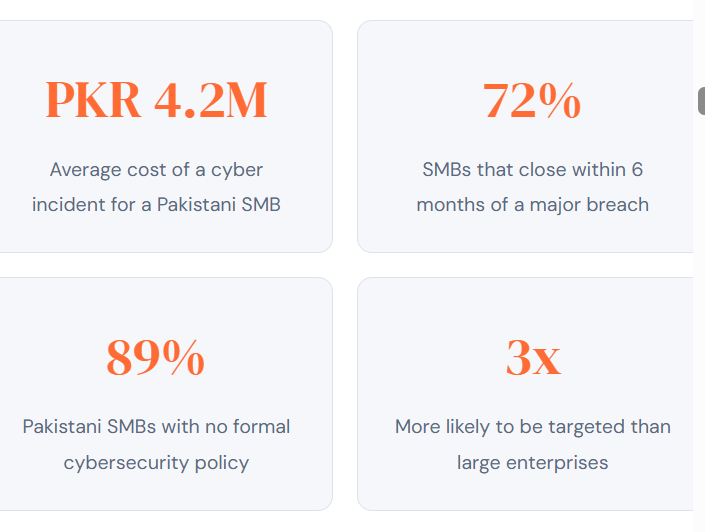
The financial damage from a single data breach incident can be catastrophic. Consider these regional realities for 2026:
Beyond finances, a cyber attack on a small business in Pakistan can destroy years of customer trust. Under the Prevention of Electronic Crimes Act (PECA) 2016 and upcoming data protection regulations, businesses may also face legal liability for data loss, regulatory fines, and criminal prosecution.
2. Top Cyber Threats Targeting Small Businesses in Pakistan
Understanding your enemy is the first step. In 2026, the most dangerous cyber threats for Pakistani businesses include:
| Threat Type | How It Works | Risk Level | Common Target |
| Phishing Attacks | Fake emails/SMS tricking staff into revealing credentials | 🔴 Critical | E-commerce, retail, banking SMBs |
| Ransomware | Malware encrypts all data; demands payment (often in crypto) | 🔴 Critical | Healthcare, manufacturing, logistics |
| Business Email Compromise (BEC) | Impersonates executives or suppliers to redirect payments | 🔴 Critical | Import/export, wholesale |
| Mobile Banking Fraud | Exploits JazzCash, EasyPaisa via SIM-swap or fake apps | 🔴 Critical | All cash-heavy SMBs |
| Supply Chain Attacks | Compromises vendors or software your business trusts | 🟡 High | Tech & services firms |
| DDoS Attacks | Flooding your website/server to knock it offline | 🟡 Medium | Online businesses, SaaS |
Pakistan-specific threats also include WhatsApp-based fraud, fake job offer scams targeting employees, and identity theft through CNIC data — all of which have spiked dramatically in 2025–2026.
3. Building Your Cybersecurity Framework
A cybersecurity framework for small businesses doesn’t need to be complex or expensive. The globally recognized NIST Cybersecurity Framework provides five core functions that any Pakistani SMB can adapt:
List all devices, software, data, and third-party access points. You can’t protect what you haven’t mapped.
Deploy firewalls, antivirus, MFA, and employee training. This is your primary defense layer.
Set up alerts for unusual login attempts, data transfers, or unauthorized software installation.
Document step-by-step actions if a breach occurs: who to call, how to isolate systems, and how to notify affected parties.
Regular backups, recovery testing, and a clear business continuity plan reduce downtime dramatically.
4. Password & Access Management
Weak passwords remain the #1 entry point for hackers worldwide — and Pakistani businesses are no exception. Password security best practices are free to implement and dramatically reduce your attack surface.
Essential Password Rules for Your Business
- Use apassword manager(Bitwarden, 1Password) for all staff — never reuse passwords
- Enforcemulti-factor authentication (MFA)on all critical accounts (email, banking, cloud storage)
- Require passwords of at least 14 characters with mixed characters
- Immediately revoke access of departed employees — on their last day
- Applyleast privilege access control— staff only see what they need
- Never share passwords via WhatsApp, SMS, or email — use your password manager’s sharing feature
💡 Pakistan-Specific Tip
Many Pakistani SMBs use shared WhatsApp groups for team communication — including sending passwords and financial information. This practice is extremely dangerous. Implement a secure communication tool like Signal for Business or Microsoft Teams with E2E encryption.
5. Network Security Essentials
Your business network security in Pakistan is the digital front door of your company. Whether you’re running a PTCL DSL line, a fiber connection, or using a mobile hotspot, these steps apply to every Pakistani SMB.
Wi-Fi & Router Security
- Change default router admin passwords immediately after installation
- UseWPA3 encryptionon your business Wi-Fi (or WPA2 as minimum)
- Create a separateguest network isolationfor customers and visitors
- Disable WPS (Wi-Fi Protected Setup) — it’s a known vulnerability
- Regularly update your router firmware — most ISPs don’t do this automatically
Firewall & Endpoint Protection
Every business computer should have a next-generation firewall and endpoint detection software. Free options like Malwarebytes (free tier), Windows Defender (built-in), and Bitdefender Free work well for micro-businesses. For 5+ employees, invest in a business-grade solution.
VPN Use in Pakistan
Using a VPN for business security Pakistan is especially important if your team works remotely or uses public Wi-Fi in cafes and co-working spaces across Karachi or Lahore. A VPN encrypts your internet traffic and hides your business data from man-in-the-middle attacks.
6. Data Protection & Backup Strategies
Data protection for small businesses in Pakistan comes down to one golden rule: if you don’t have a backup, you don’t have the data. The 3-2-1 backup rule is the industry standard:
Encrypted Data Storage
All sensitive business data — customer records, CNIC copies, financial files — should be stored with AES-256 encryption. Windows BitLocker and macOS FileVault provide full-disk encryption at no additional cost
Cloud Security in Pakistan
Many Pakistani SMBs now rely on cloud storage security through Google Workspace or Microsoft 365. These platforms are excellent — but your security configuration matters. Always enable two-factor authentication, review third-party app permissions regularly, and restrict sharing to “only people within organization” by default.
7. Phishing & Social Engineering Defense
Phishing attack prevention Pakistan must be a priority because this is the most common and most successful attack vector against Pakistani businesses. Phishing uses deception — not technical hacking — which means your employees are both the greatest vulnerability and greatest defense.
Recognizing Phishing in a Pakistani Context
Attackers increasingly use localized phishing tactics — messages in Urdu, fake FBR (Federal Board of Revenue) tax notices, fake SBP (State Bank of Pakistan) alerts, and impersonation of popular local services like JazzCash, EasyPaisa, and NADRA.
- Always verify sender email addresses — not just display names
- Never click links in unsolicited emails; go directly to the website
- Train staff to recognizespear phishing— targeted attacks using personal details
- Verify any unusual payment requests via a phone call — never by replying to the email
- Useemail authentication protocols(SPF, DKIM, DMARC) on your business domain
- Run quarterly phishing simulation exercises for staff
8. Legal Compliance: PECA, PTA & Data Protection Laws
Cybersecurity compliance for businesses in Pakistan is no longer optional. The legal landscape is evolving rapidly, and SMBs that ignore it face fines, prosecution, and reputational damage.
9. Affordable Cybersecurity Tools for Pakistani SMBs
Budget is always a concern for Pakistani small businesses. The good news: affordable cybersecurity solutions for SMBs have never been more accessible. Here’s a practical toolkit categorized by cost:
Free / Built-In Tools
- Windows Defender— built-in antivirus, surprisingly robust for basicmalware protection
- Bitwarden(free tier) — excellentpassword managerfor teams up to 5
- Google Workspace MFA— free two-factor authentication on all Google accounts
- Have I Been Pwned— check if your business email has been in a known breach
- Cloudflare Free— basicDDoS protection and CDNfor your website
Low-Cost Paid Tools (PKR 1,000–5,000/month)
- Microsoft 365 Business Basic— email + Teams + OneDrive + basic security features
- Malwarebytes for Teams— excellentendpoint protectionfor small teams
- NordLayer (business VPN)—remote access VPNwith Pakistani server options
- Acronis Cyber Protect— integratedbackup and ransomware protection
Local Resources in Pakistan
- NCCPL / NCCS (National Cyber Emergency Response Team)— government cybersecurity resources
- FIA Cybercrime Wing— report incidents at cybercrime.gov.pk
- P@SHA (Pakistan Software Houses Association)— industry resources and vetted local IT security vendors
10. 2026 Cybersecurity Checklist for Pakistani SMBs
Use this cybersecurity checklist for small businesses Pakistan as your quarterly review guide. Print it, share it with your team, and tick it off systematically.
✅ Immediate Actions (This Week)
- Enable MFA on all email accounts, especiallyGoogle Workspaceand Microsoft 365
- Change all default router and device passwords
- Install and update antivirus on every business computer
- Back up all critical business data to the cloud today
- Audit who has admin access to your systems — revoke unnecessary access
✅ Short-Term Actions (This Month)
- Implement awritten cybersecurity policyfor employees
- Conduct asecurity awareness trainingsession with all staff
- Set upautomated backup schedulingwith offsite/cloud replication
- Review and update all software — eliminate unlicensed or pirated programs
- Create anincident response planwith key contacts (IT vendor, bank, FIA)
Ongoing Actions (Every Quarter)
- Run a simulatedphishing teston your employees
- Review access logs and terminate inactive user accounts
- Update your business continuity plan
- Check for updates toPECA compliance requirementsand PTA guidelines
2026 Cybersecurity Pakistan Guide · This content is for informational purposes only and does not constitute legal or professional security advice.
Primary Keyword: Cybersecurity Guide for Small Businesses in Pakistan 2026.